Literacy as a TOOL for Learning
Disciplinary Literacy: Adapt Not Adopt
By: Alexis Gounaris
I don't know about you all, but when I was in high school Science and Math classes I dreaded the day we were going to be forced to write about our thinking for a Math problem or when we were asked to infer WHY this happened in this experiment. I thought to myself "why in the world am I writing out a plan and my thinking of solving this math problem why can't I just solve it" and "this is math class why am I writing a paragraph?!". In Science, I dreaded inferring why something happened because I feared it being wrong. Along with that, the graphs and charts we had to study in both subjects and think about what they were telling us. Fast forward to today, I realize the importance of both of those things and I am glad my teachers were able to force me to critically think rather than just be expected to crank out the formula or write down the observations. It gave me a deeper understanding of what was being taught.
Question: What was your experience in these classes, were you pushed to do more than just solve the problem and write your observations?
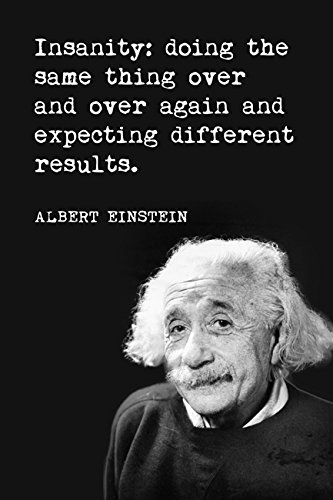
Victoria Gillis includes Albert Einstein's quote: "Insanity: doing the same thing over and over again and expecting different results." to explain how every teacher is not a teacher of reading and if we continue with the notion in our heads that every teacher is a teacher of reading it is the wrong way to approach the problem at hand. Telling a Science teacher they are a teacher of reading teacher would be like an accountant telling me how to do my job as an elementary school teacher. Rather than a Science teacher (for example) being a teacher of reading, a Science teacher can be a teacher can improve student learning and their literacy simultaneously" (Gillis, 614). There are ways to implement literacy into any classroom that can take what they're already learning to the next level. Literacy should be sprinkled in EVERY classroom, not just the English classroom. For us as Elementary Education teachers we also need to know how to implement literacy in all the subjects that we teach.
In the article, Gillis introduces the the Response Heuristic organizer, a way to get what students are already thinking in their heads down on paper. Using the Response Heuristic graphic organizer is a great way to "reflect the kinds of thinking found in the different content areas" (Gillis, 618). This gets students on a deeper level of thinking rather than just doing the work and being done. The examples used in the article showed an organizer for each subject and ways to explore students critical thinking. We know not every teacher is a reading teacher, therefore not every teacher should be teaching reading. BUT every teacher's goal, no matter the grade, should be to educate students and make them feel comfortable and capable in thinking critically about issues important to them as well as things they are learning. Allowing your students to have discussions and be able to hear what others have to think is such an important first step for any type of classroom. If elementary students are pushed to think deeper in the classroom why are secondary students not being forced to critically think in their Science, Math, and Geography courses?

Students also need to be educated on how to read a piece of literacy to understand information more. The information should not just be given to them, they need to be taught how to read that chart or how to read that map in Geography. When I think back to school I feel like there were times I was given pictures, charts, or graphs that my teacher assumed we understand but most of the class had no idea how it connected with what we were being taught. In that case what the piece of literacy is not being properly utilized. While it is SOOO valuable to have visuals like that, every content area teacher need to know how explain or teach how that visual connects with what they're learning. Visuals enhance the learning being done!

I think some of the problem that stems from content area teachers is that they become lazy and think if they aren't teaching an English class, they dont need to teach or overview any kind of literacy practice. They have that mindset going in that is not their job, so they become resistant to the idea. It is not hard to implement critical thinking and investigating things they learn. What's holding them back is putting in that extra effort to do more with what you're teaching.In each content area there is way to dig deeper into what they're being taught. Not everyone's disciplinary strategies will look the same because you must ADAPT them for your classroom and content area.
I have attached a video (click link below) I found on YouTube that shows how four content area teachers demonstrate what disciplinary literacy looks like in their classrooms! It is such a great way to see it in action!
Questions to ponder...
- In your own words how would you define disciplinary literacy?
- What would a school look like where disciplinary literacy is not implememnted? How would you change things if you took the position of Principal at this school?
- Taking the question Gillis asks (because I am curious what you all think) "If primary and elementary students can learn discipline appropriate ways of thinking, why do we assume secondary students cannot do so?" (Gillis, 615).
- What is a potential problem when you put content first?
- Why do you think content teachers are so resistant with bringing disciplinary literacy into their classrooms?


Alexis,
ReplyDeleteI really enjoyed how you started off with your own experience on your blog, it made me think about connections to my own education prior to college. I had a similar experience, and did not understand why we were doing these things that I thought were unnecessary in classes like Science and Math. I think if the teachers would've explained why and the purposeful meaning behind why, things would have made a lot more sense. Like the articles mentioned, it is so important that we are teachers of literacy, and that literacy shows in all our subjects. Understanding literacy is like the foundation we set, and then we use it to build on top of all other knowledge.
Referring to your question about the problem with putting content first, I think it is a problem because in a lot of classrooms there is a heavy focus on one or two things, not all subjects. So for instance, there is a lot of stress for Math and Reading (not just literacy in general). So yes, the students are going to continue to fail the state wide tests year after year because we try to teach for the test and then the students don't actually understand literacy in an authentic way. We also are completely disregarding subjects like science and history a lot of times in the elementary setting, which are both great subjects where you can easily implement literacy and make the learning experience authentic.
Thank you so much for your response, Jazlyn! I totally agree with you that if teachers would have further explained why we were doing these things I would have had a better attitude about and actually gotten something from it. Literacy has to show in every subject in order for your students to get every thing out of a subject. You're so right about how elementary teachers tend to disregard history and science which is setting them up for failure int heir future years when they're hit with both of those subjects but has never been exposed to it.
DeleteFirst off, great blog post Alexis! I totally agree with you when you bring up how you dreaded having to explain yourself in science and math. I knew how to complete the problems or I knew the processes, but could never articulate how I could arrive to these conclusions. Therefore, that showed me that I didn't truly understand the material, I only understood them at a surface level comprehension. This is why I hope to focus more on actually learning the material, rather than just making sure my students can get the right answer. Obviously this can be done with students writing out their thought processes while solving problems! I know that my students may hate this, but I definitely want to push them to first of all answer the problems that I give them but for them to also write out their thoughts. This way as a teacher I can gauge how well they understood the lesson, and I can assess if I need to revisit this standard! Many teachers just teach to the test, but if we really focus on the learning first our students will be better off!
ReplyDeleteThanks Aubrey! You're exactly right, I knew how to crank out the formula or the process but could never fully understand how or why this formula worked. It did make me feel sort of dumb because I felt like I should know the explanation behind the process I was doing. I want my students to KNOW how and why processes work before they memorize a certain formula. I definitely think having students write out their thought processes and actually getting them down on paper will help them tremendously in actually learning the material! It is a very good way to gauge where they are in the lesson! As future teachers, we cannot continue to teach the test.
DeleteI loved hearing about your high school experience because mine was very similar! I too dreaded having to explain myself, but now I have a great appreciation for the teachers that made me. I appreciate my math teacher freshman year who would make us confidently explain how we got each of our answers when we shared with the class. Back then it was awful, but he obviously knew what he was doing by incorporating disciplinary literacy. I think a potential problem with putting content first is that students miss out on other opportunities for learning. When teachers are so driven to push content to achieve higher standardized test scores, they leave out important skills such as critical thinking and other knowledge about that world that could actually potentially help students. They also may bore the students and not allow them to think for themselves. Incorporating literacy into every subject is a better way to help students literacy skills improve rather than pushing content only during english class.
ReplyDeleteI am starting to realize most of our experiences were the same with dreading having to explain ourselves because it was not something we were used to doing. Looking back on it today, I am thankful for the few teachers (who I may have not liked at the time) but pushed me to think deeper into what we were doing rather than just let us take the easy way out. You're totally right that putting content first messes with their opportunity to learn more and go deeper into what they're learning. Teachers focus too hard on teaching the test rather than teaching students important skills about thinking critically. Thanks for your response!
DeleteAlexis,
ReplyDeleteI like how you pointed out how one of our goals as elementary teachers should be to create a community of learners that can carry on discussions and listen to the ideas of others around them. When you reflected on your own experiences in school, specifically your fear of having the wrong inference as to why something happened, this stood out to me. I also remember feeling this way in my previous schooling experiences, and I think many people could also relate. These questions were always framed as, "Why do you think this happened?" but I still remember several times that I was counted off points for not having the same thoughts as my peers or teacher. I feel like we should encourage our students to look at the world in a different way, especially if we are asking for THEIR OPINION. I think this is a part of the hesitancy to incorporate disciplinary literacy into our classrooms. It is often difficult for us to picture an environment that can still have good class management but encourage our students to think critically about the world and everything around them. I hope that makes sense. :)
I do remember being counted off for dumb points because my answers weren't the same as my teachers was. That was something that also really frustrated me because I didn't feel it was fair that I was getting things wrong because my opinions weren't the same as my teachers.Not everyone is going to have the same viewpoints and why should teachers be penalizing when they're students have different ideas. Thanks for bringing that up because that was something that made me upset as a student as well. When students feel they're going to be wrong it causes them to shutdown and not share what they're thinking.
DeleteOh my goodness, girl! PREACH IT! I could not stand the explanations we had to write for the thinking critically sections in math and science! I always knew how to do the problem or what they answer was, but I never understood why I was taking the steps I was to get the answer. It made me so mad and I would just want to throw hands and give up. I think the problem with only teaching content is making students feel exactly how we felt. They feel unprepared, annoyed, and discouraged. It actually is pretty sad. They are discouraged to learn because they are being forced to regurgitate what they have been told, not truly learn and understand the critical literacy of the content. We have to teach our students the literacy within what they are being asked to learn and perform.
ReplyDeleteYes, I totally feel you!! I was so focused on the fact that I knew what the answer is and how to do the problem but I never understood the importance of each step I was taking to get my answer. Whenever teachers try push students to think deeper and beyond just the content, that is when students automatically get frustrated because it is out of their norm and I think that thinking needs to shift to being something they're used to doing rather than something they dread doing.
DeleteI can totally relate to the frustrations and anxieties that come along with writing out explanations for math. In my head all that mattered was that I knew how to do it, so why did I have to explain it beyond showing my work? Whenever I had to deconstruct the meaning behind an equation or experiment I would always overthink it and not know where to start. I was terrified of not getting it right even though I knew how to do the work! It's so important to incorporate those skills into more than just English/Writing classes. After all, literacy is not as limited in application as school makes it out to be sometimes. That being said we can't just mash the two subjects together all willy nilly, which is why I love how you offered examples and helpful resources in your post. Great job!!
ReplyDeleteThe explanations in math were definitely what really got me and made me honestly feel dumb because I could get the WHY part and how this certain formula works or how I got the answer I did. We are so pushed to show our work in math but we aren't pushed to provide and explanation or think any further than the bare minimum. I also feared not getting my explanation part right even though I clearly could do the work. I felt that my teacher would say thats the wrong way to explain it even thought you're getting the right answer. Thanks Sam!
Deletei love how you mentioned your high school experience because that is something i experienced especially in math! i always wanted to just crank out the math problems and copy the formulas but i wasn’t actually learning anything or developing critical thinking which is a major life skill every child should have! i loved when you said “What's holding them back is putting in that extra effort to do more with what you're teaching.In each content area there is way to dig deeper into what they're being taught.” because our job as a teacher never really ends, even after we leave for the school day. I enjoyed your blog and everything you had to say was valid and relatable! the video attached was also really well put and fit this perfectly
ReplyDeleteThanks Bailee! I definitely can tell we all had some similar experiences in high school with further explaining ourselves in Math and how we focused more on getting the right answer and using the correct formula rather than being able to explain why a certain formula worked. Critical thinking is for sure a very important important skill for kids to develop and what is going to happen when they move onto college and can't critically thinking beyond the right answer.
Delete